
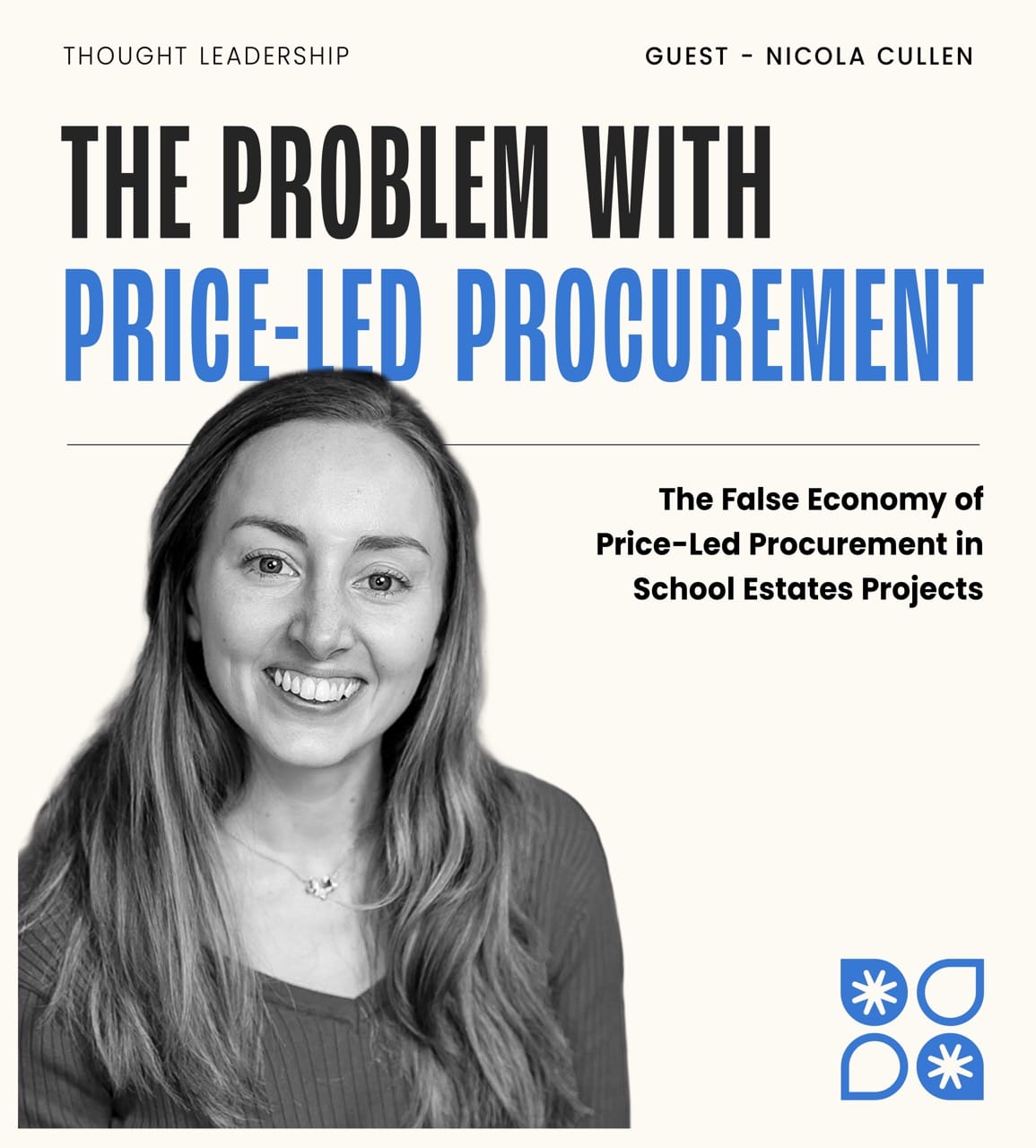
The False Economy of Price-Led Procurement in School Estates Projects
Why better questions, better evaluation and the right expertise can deliver better value for money.
Schools are under considerable financial pressure. When it comes to capital projects, it is therefore understandable that price can become a dominant consideration. A lower tender price appears to offer an immediate saving, while a straightforward procurement process can also reduce the time and resource required to get a project underway.
But there is a danger in equating a lower price with better value.
When procurement becomes overly price-led, evaluation can become simplified to the point where the factors that genuinely determine whether a project will be successful are given insufficient weight. The result can be a contractor who is cheaper on paper, but a project that ultimately costs more through poor delivery, variations, delays, quality issues or the need to address problems that could have been avoided.
Being cost-conscious is essential. But focusing on price at the expense of quality can itself become expensive.
Ask what they have done, not just what they would do
One of the most effective ways to improve evaluation is to focus on evidence. Procurement questions often ask suppliers what they would do: how they would manage a project, approach a particular challenge or deliver a particular outcome. These questions have value, but there is a limit to what they can tell you. Any competent bidder can describe a convincing methodology.
The more revealing question is: what evidence can you provide that you have done this successfully before?
Evidence of relevant experience can provide a much stronger basis for differentiation between bidders. This might include examples of similar school projects, experience of managing safeguarding considerations in live education environments, demonstrable environmental benefits where these are a core requirement, or examples of challenges encountered and lessons learned.
The objective is not to reward suppliers simply because they have worked on a large number of projects. It is to understand whether they have relevant, demonstrable experience of delivering the outcomes that matter to your particular project.
A supplier’s ability to articulate what they will do is useful and their ability to demonstrate what they have done can be much more valuable.
Better questions don’t mean longer submissions
There is also a misconception that a high-quality procurement exercise needs lengthy tender documents and extensive bidder submissions, but it doesn’t.
In many cases, fewer, more meaningful questions will produce better information than a long list of questions that encourages suppliers to provide generic responses.
Good evaluation questions should get to the crux of the issue. They should focus on tangible outcomes, relevant experience and evidence, rather than simply asking suppliers to describe their approach in increasingly detailed terms. This can benefit everyone involved.
For suppliers, it means they can focus their effort on demonstrating why they are suited to the project rather than producing pages of generic material. For schools and trusts, it makes evaluation more manageable and creates a clearer basis for comparing bids.
The quality of a procurement exercise is not measured by the number of pages it produces. It is measured by the quality of the information it generates and the decisions that information enables.
Moderation should be a value-for-money stress test
Moderation is another area where the procurement process can add considerably more value than simply checking that scores have been calculated correctly.
Effective moderation should test whether the evaluation methodology has been applied consistently, whether evidence has been considered fairly and consistently, and whether the outcomes can be properly justified. In other words, moderation should challenge the decision-making process.
Why did one bidder score higher than another? Was that difference supported by evidence? Have evaluators interpreted the question and scoring criteria consistently? Would the rationale for the decision stand up to scrutiny if it were challenged?
Thinking about moderation in this way turns it into a value-for-money stress test.
It provides an opportunity to step back from the individual scores and ask whether the procurement process has genuinely identified the supplier most likely to deliver the required outcomes.
Expertise is an investment, not a cost
Getting this right requires the right people around the table. Procurement and estates projects can be complex, and schools and trusts do not necessarily have all of the specialist expertise they need available internally. Bringing in appropriate technical and procurement expertise should therefore not be viewed simply as another project cost.
It is an investment in the quality of the decision.
Well-designed procurements, supported by people who understand both the technical requirements of a project and how to structure effective evaluation, can lead to more meaningful criteria, stronger assessment of bids and greater confidence in the eventual outcome.
The cost of getting that expertise involved at the outset can be relatively small compared with the cost of making the wrong decision further down the line.
Better procurement doesn’t mean more complicated procurement
Schools do not necessarily need more complicated procurement processes. They need better questions and better evaluation of the answers.
In a sector where every pound matters, the objective should not simply be to identify the cheapest contractor. It should be to identify the supplier most likely to deliver a successful project at the best overall value, those are not always the same thing.
The difference between the two outcomes may sometimes come down to just a couple of well-considered questions: asking for evidence rather than promises; testing relevant experience rather than accepting generic methodology; and properly interrogating the scores during moderation.
That may sound like a small change, but in a major school estates project, small improvements in the quality of procurement and decision-making can have a significant impact on the quality, cost and success of the finished project.
Ultimately, value for money is not about paying the lowest possible price, it’s about making the best possible decision with the money available.
About the author
Nicola is an Associate at Capital Law and specialises in public procurement. She works closely with schools, colleges and other public sector organisations to help them procure goods, services and works compliantly, efficiently and with confidence.
From planning and running procurements to managing contracts and resolving procurement challenges, Nicola provides practical, commercial advice that helps organisations achieve their objectives while meeting their legal obligations. Her aim is to make procurement accessible and straightforward, enabling clients to focus on delivering positive outcomes for their communities.
