

Why Comfort Should Be the Measure, Not the Closure
In late June 2026, a heatwave pushed UK temperatures past 36°C. More than 1,000 schools in England fully or partially closed, or sent pupils home early, according to press reports collated at the time.
Behind each closure was the same question being asked in a trust office somewhere: is this building still safe and comfortable enough for children and staff? For many leaders, the honest answer was no – followed by the harder part: an email to parents explaining why school was closing again.
School should be a safe and comfortable place for children and staff. That isn’t aspirational, it’s the baseline.
Closures make headlines, but they are only the visible tip of the problem. A classroom that regularly drifts into the high twenties by mid-afternoon doesn’t need to close to cause a problem. It simply makes concentration harder and the school day less comfortable for pupils and staff alike. You don’t need a closure event to justify taking overheating seriously.
There is also no simple legal line to point to. The Workplace Regulations 1992 set a recommended minimum indoor temperature of 16°C, but there is no equivalent legal maximum. The HSE is reviewing that gap in 2026. For now, when a classroom reaches the low thirties, there is no statute that says close it; the judgement sits with the people responsible for the building.
It’s tempting to see this as an air conditioning problem, but usually, it isn’t.
A Building Designed for a Different Climate
Much of the English school estate was built, or last refurbished, in an era when solar gain was seen as a benefit rather than a risk. Large south – and west-facing areas of glazing were popular in 1960s and 70s buildings, and have returned to favour in newer designs where daylight is prioritised. Single glazing, tired secondary units and internal blinds that do little once heat has already passed through the glass remain common across parts of the estate, and most schools have never been formally assessed against CIBSE TM52 overheating criteria.
Why the Window, Not the Wall?
Fabric-first thinking naturally points towards insulation, and that isn’t wrong. But wall and roof insulation primarily manage winter heat loss. They don’t address the rapid solar gain that can drive summer overheating. Glazing does both jobs.
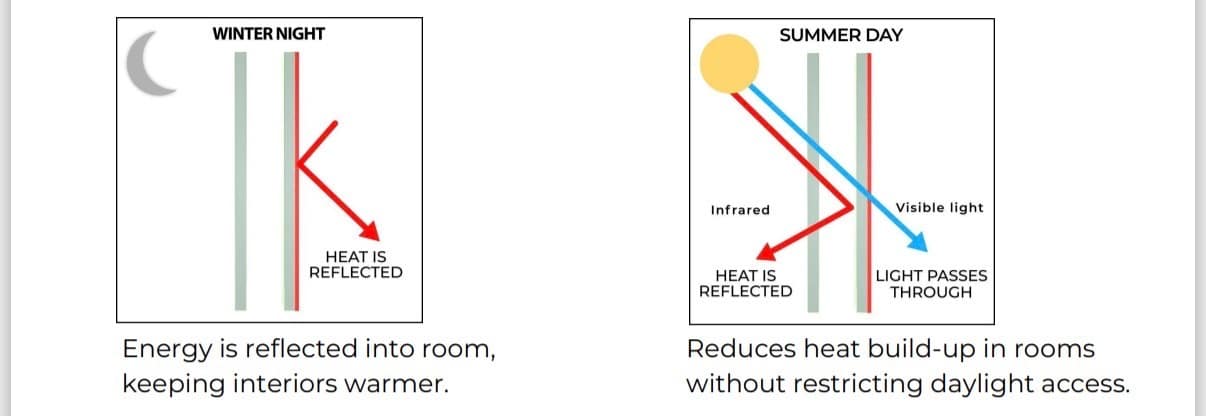
A window that stops heat coming in during a June afternoon is the same window that helps keep heat in on a January morning. One measure worth considering is retrofit window coating: a thin, optically clear gel applied directly to existing glass without removing the window.
What it is specified to do includes:
- Infrared: block more than 80%, rising to 93% in independent site testing.
- UV: block more than 99%, reducing fading and exposure risk.
- Solar energy: reduce transmission through the glass by up to 87%, while retaining much of the available daylight.
- Thermal performance: published university research has recorded a 30% improvement in U-value and a 36% reduction in solar heat gain coefficient.
- Embodied carbon: manufacturer lifecycle data puts this at less than 1% of a full window replacement.
None of this requires changing the frame, wall or roof. Application can typically be completed within days, potentially fitting within a half-term rather than requiring a summer closure.
It is worth distinguishing this from tinted adhesive films used primarily to reduce glare. Many are PVC or polyester laminates with different fire performance characteristics. The products being considered for schools should be checked against the relevant test certification, including confirmation of non-combustibility where this is a requirement.
The Argument Doesn’t Wait for Summer
The same glass works throughout the year. A 30% improvement in U-value means the building loses heat more slowly in winter, reducing the energy and time needed to bring a cold classroom up to temperature before the first bell.
It can also reduce condensation on cold single glazing, potentially helping with mould risk in older classrooms. This isn’t a summer fix, it’s a year-round comfort and building performance measure.
The Luxury Most Schools Don’t Have – Yet
Mechanical cooling isn’t something most English schools currently have, or can easily justify. It is expensive to install and run, and difficult to prioritise ahead of safety-driven condition works.
Reducing solar gain at the window can reduce the need for cooling before that question even arises, without introducing an ongoing running cost.
But the wider pattern is worth watching. Met Office data confirms that summer 2026 was provisionally the UK’s hottest on record, with the six warmest UK summers all occurring this century. If that pattern continues, some trusts will move from asking whether they need cooling to asking how much.
A building that has already reduced its solar gain by 80-90% needs a smaller system to finish the job. Specifying measures now could therefore make a future cooling decision simpler and less expensive.
A Fix That Pays Back Twice
Financial modelling on buildings with substantial glazing indicates typical payback within five to six years against combined heating and cooling costs.
Independent monitoring of live installations has also recorded significant reductions in HVAC energy use, alongside internal temperatures tracking closer to target setpoints than uncoated comparators.
Which measure makes sense will vary from site to site. A listed building, or a building with sound glazing that still overheats, may favour a coating. A block already scheduled for major fabric works may justify full window replacement instead.
The right answer comes from the survey, not the spec sheet.
Building the Case Once, Not Twice
Most trusts already know when a boiler is on borrowed time. A CIF bid is usually built around that failure risk: a heating system that could leave a school cold. But the same building can have both problems at once. The June 2026 closures are exactly the kind of evidence that a straightforward heating replacement doesn’t necessarily capture.
A CIF submission built solely around boiler failure risk can miss half the case for a school where children have also been sent home because classrooms became too hot. Recording overheating incidents, closure dates and room temperatures alongside the usual condition evidence creates a fuller picture of the building’s needs.
It also means a window coating scope can potentially be developed alongside a heating project already going to tender, sharing site mobilisation and surveys rather than becoming two separate projects competing for two different funding rounds.
For a trust with a boiler already flagged for replacement, this is the moment to ask the surveyor to record the summer picture too, not just the winter one.
The heatwave gave every trust a stress test they didn’t ask for. The useful question now is whether the next email to parents is one you’re forced to send or one you never have to write.
If your estate came through June 2026 with rooms that became too hot to teach in, I’d be happy to talk through what an overheating risk review could look like for your sites.
Contact me directly at james@warnefordconsulting.com.
James Smurthwaite MCIOB
Partner, Warneford Consulting
James is a sustainability-focused engineer and consultant with over 15 years of experience in building services. Since graduating in Mechanical Engineering in 2007, he has worked across industrial cooling, heat pump adoption and corporate decarbonisation, developing strong technical expertise and a clear focus on accelerating the shift to low-carbon, energy-efficient buildings.
As a Partner at Warneford Consulting and previous founder of Green Net Zero, James leads on energy and carbon reduction, with a particular focus on the education sector. His work helps schools secure funding, improve energy performance and reduce emissions, creating more sustainable and resilient estates.
