
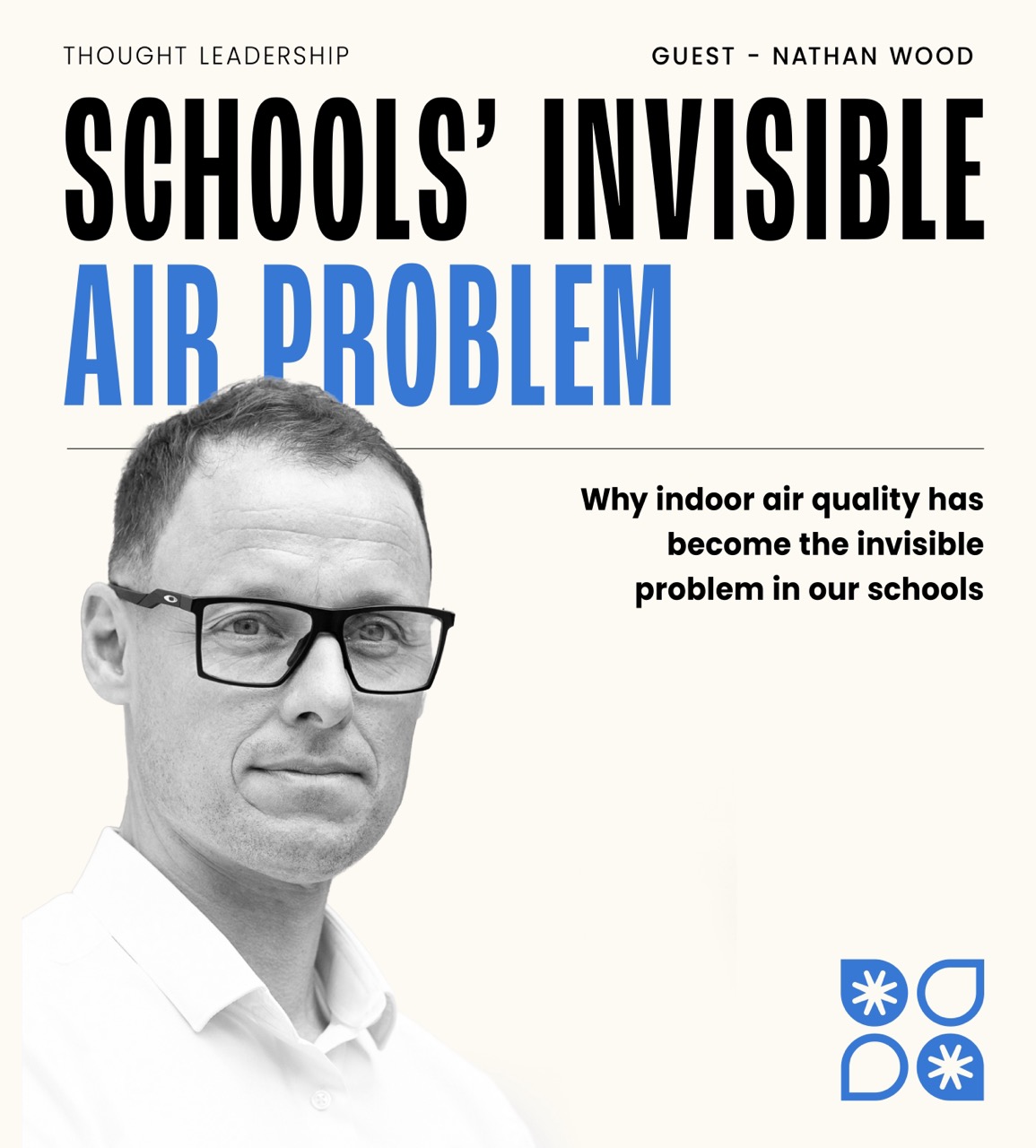
Why indoor air quality has become the invisible problem in our schools
Nathan Wood, guest
Nobody remembers the air in their old classroom, do they?
They remember the teacher who made them laugh, the friends they sat with, the classroom that was always freezing and the one that somehow became unbearably hot before break time. They remember the window that never shut properly and the radiator that was either stone cold or scorching hot.
But the air itself? Probably not.
For nearly 25 years I’ve worked in ventilation and building performance. Over the last decade, indoor air quality has become a much bigger part of my work, my conversations and, if I’m honest, my frustrations.
It means I notice things other people don’t.
The stale room. The damp corner. The classroom where the windows have quietly become the entire ventilation strategy. The fan that’s running but isn’t really doing what everyone thinks it’s doing.
So yes, I suppose that makes me a bit of an air snob and I’m fine with that.
Because once you start noticing air, you can’t stop.
When poor air becomes normal
Walk into enough schools and you begin to recognise a pattern.
Some classrooms feel heavy, flat, stale. The sort of room where everyone has accepted something is wrong because it’s felt wrong for so long.
The teacher knows. The caretaker knows. The pupils probably know too, even if they don’t have the language to describe it.
Nobody talks about ventilation rates or CO₂ concentrations. Instead, they say things like:
“Everyone seems tired in this room.”
“The children struggle after lunch.”
“We open the windows but then it gets too cold.”
“We close them and everyone feels rough.”
Then the bell goes and everyone carries on.
Because that’s what schools do. They carry on.
“A headteacher can’t ventilate a classroom with good intentions.”
Schools know there’s a problem
The reality is that most schools care deeply about their buildings and the people inside them.
The challenge is that they’re already being asked to do more with less.
Improve attendance, raise attainment, support mental health, manage SEND provision, retain staff, reduce energy use, maintain ageing buildings.
Then someone says they also need to solve their ventilation challenges.
Of course they do. But with what?
A broken ventilation system doesn’t repair itself because guidance exists. Damp doesn’t disappear because somebody has written a strategy. Poor air quality doesn’t improve because it’s been discussed in a working group.
Schools need funding, technical expertise and practical support.
Without those things, responsibility simply gets pushed down to people who don’t have the resources to solve the problem.
The hidden cost of poor air
The challenge with indoor air quality is that its impact is rarely dramatic.
It’s cumulative. A room feels a little heavy.
Children become slightly less alert.
Teachers feel a little more drained. Absence creeps up. Concentration drops.
The environment becomes harder to work in.
None of these things happen overnight. But over weeks, months and years, the impact compounds.
That’s why poor air quality shouldn’t be viewed as a facilities issue. It’s a learning issue. A health issue. A workforce issue. A building performance issue.
When the air is wrong, everything else becomes harder.
“Children can’t breathe reports. Teachers can’t open a PDF and get outside air into a classroom.”
Ventilation is not the same as air cleaning
One of the biggest misconceptions in recent years has been the idea that air cleaning technology can somehow replace proper ventilation.
It can’t. Filtration has a role. Air cleaning has a role. Both can be valuable tools in the right circumstances. But neither replaces the fundamentals.
Filters don’t remove CO₂. They don’t introduce outside air. They don’t deal with moisture in the way properly designed ventilation systems do.
Too often, a product is installed, a photograph is taken and everyone feels like progress has been made.
But the real questions remain:
- Has the room actually been assessed?
- Is enough outside air reaching occupants?
- Is the system operating as designed?
- Has maintenance been carried out?
- What happens when 30 pupils occupy the room at 2pm on a winter afternoon?
That’s where the truth usually lives. Not in the brochure. In the classroom.
We already have the evidence
The Department for Education’s Condition Data Collection programme has been gathering information on the condition of the school estate since 2021, including ventilation, damp, heating systems and wider building performance.
The evidence is being collected.
The challenge is no longer understanding whether problems exist.
The challenge is deciding what happens next.
Because if a school was struggling with ventilation and building condition in 2021, what does that building look like today after years of rising costs, deferred maintenance and stretched budgets?
Many school leaders already know the answer.
They see it every day.
Why this matters beyond the classroom
Poor indoor air quality is often treated as a building issue when its consequences extend far beyond the estate itself.
Children who are healthier attend more lessons. Teachers working in better environments are more effective and less fatigued. Parents take fewer days off work. Health services experience less pressure. Educational outcomes improve.
These benefits don’t sit neatly within a single department or budget line, which is one reason the issue often struggles to attract sustained attention.
But that doesn’t make them any less real.
Health economists talk about Quality Adjusted Life Years (QALYs), measuring not simply how long people live but how well they live.
Better air contributes to better health. Better health supports better learning. Better learning creates better life chances.
The return on investment doesn’t stop at the classroom door.
“Healthy school air shouldn’t depend on whether a school can scrape together money from a budget that’s already under pressure.”
An uncomfortable question
Parents make enormous sacrifices to secure what they believe is the best education for their children.
They move house. Change postcodes. Take on larger mortgages. Rearrange family life.
But school quality is typically judged through exam results, inspection outcomes, leadership and reputation.
What if we also considered the quality of the learning environment itself?
What if parents could easily understand whether classrooms were properly ventilated, whether systems were maintained and whether indoor environmental quality was being actively managed?
A school can have excellent leadership and committed staff.
But if children spend every day learning in poorly ventilated spaces, should that really be considered separate from educational quality?
It’s a question worth asking.
The next step
After nearly 25 years working in ventilation, I’m tired of seeing the same pattern repeat itself.
A problem everyone can feel. A system nobody quite owns. Guidance that says the right things. Schools trying their best, and insufficient resources to solve the underlying issue.
We know ventilation matters. We know indoor air quality affects health, wellbeing and learning. We know poor conditions disproportionately affect the most vulnerable communities.
The debate is no longer about evidence. It’s about action.
“Guidance without funding is just pressure. Guidance without delivery is just noise.”
Healthy air in schools should not be a luxury.
It should not depend on the knowledge of an individual headteacher, the persistence of a site manager or the volume of parents’ complaints.
It should be standard: Measured, funded, maintained and monitored.
Because until it is, we’re not just failing buildings. We’re failing the children sitting inside them.
And perhaps that’s why I still call myself an air snob.
Because once you start paying attention to the air children breathe every day, it’s impossible not to ask a simple question:
If we care so much about where children learn, shouldn’t we care just as much about what they’re breathing while they’re there?
Nathan Wood is Managing Director of Farmwood M&E Services Ltd, with 25 years in ventilation and over 10 years focused on indoor air quality.
He works across housing, healthcare, education, commercial and public sector buildings, helping turn the conversation around ventilation, damp, mould and air quality into practical action.
Nathan is involved in several industry and policy groups, including the Future Homes Standard Ventilation Implementation Group, World Ventil8 Day, GO AQS, the EIA Air Quality Working Group and wider built environment forums focused on healthier indoor spaces.
His work brings together real site experience, industry knowledge and a plain-speaking approach to help make buildings healthier, safer and better understood.
